Data centre debate heats up ahead of US midterms - here's what you need to know
Data centre debate heats up ahead of US midterms - here's what you need to know
Until a few years ago many of us may have been blissfully unaware of what a data centre was.
These giant, warehouse-like buildings power virtually all our internet activity, from our web searches and emails to movie downloads and online banking.
They are at the heart of the AI boom, housing the advanced computer chips and servers needed to run services like ChatGPT and Claude.
But the speed at which they're growing, the enormous amount of electricity they consume and concerns about their environmental impact are fuelling a public backlash around the world.
In the US, they've become a huge issue ahead of the midterm elections on 3 November, with both Republicans and opposition Democrats coming out against their development.
It's putting opponents of data centre expansion on a collision course with US President Donald Trump, who has dismissed the pushback as a "sick conspiracy", even as public anger grows.
Here's what you need to know about the data centre boom, and why opposition is growing.
They are growing rapidly
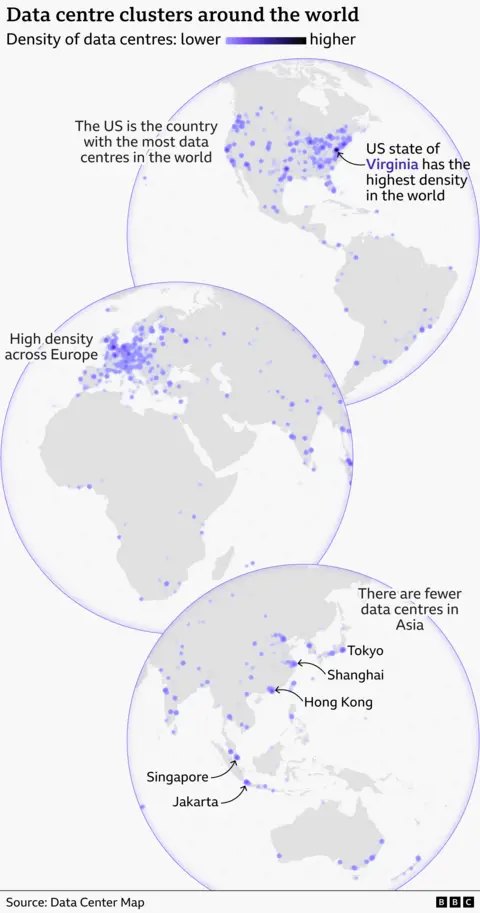
As the chart below shows, data centres are most densely clustered in the US which has 4,767 sites. It is followed by Europe, where the UK and Germany lead.
Data centres have typically been located near to cities where it's easier to access high voltage power lines or water resources for cooling. But as they get bigger, more are being built in rural areas.
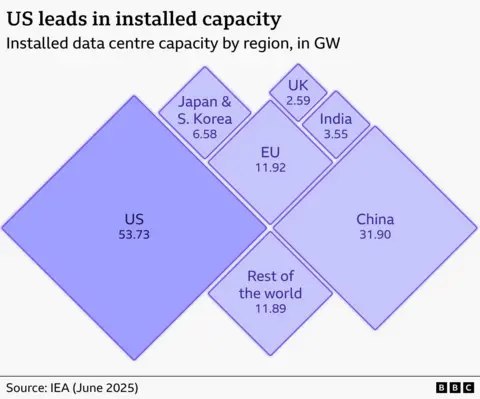
But when it comes to actual capacity, the US is ahead by a much larger margin, with China in second place and Europe lagging far behind.
They are getting bigger
The world's largest operational data centre is widely reported to be one run by China Telecom in Hohhot, Inner Mongolia, covering an area of approximately one million square metres (10.7 million sq ft). That is equivalent to about 140 Fifa football pitches.
However, much larger sites are under construction as the graphic below shows.
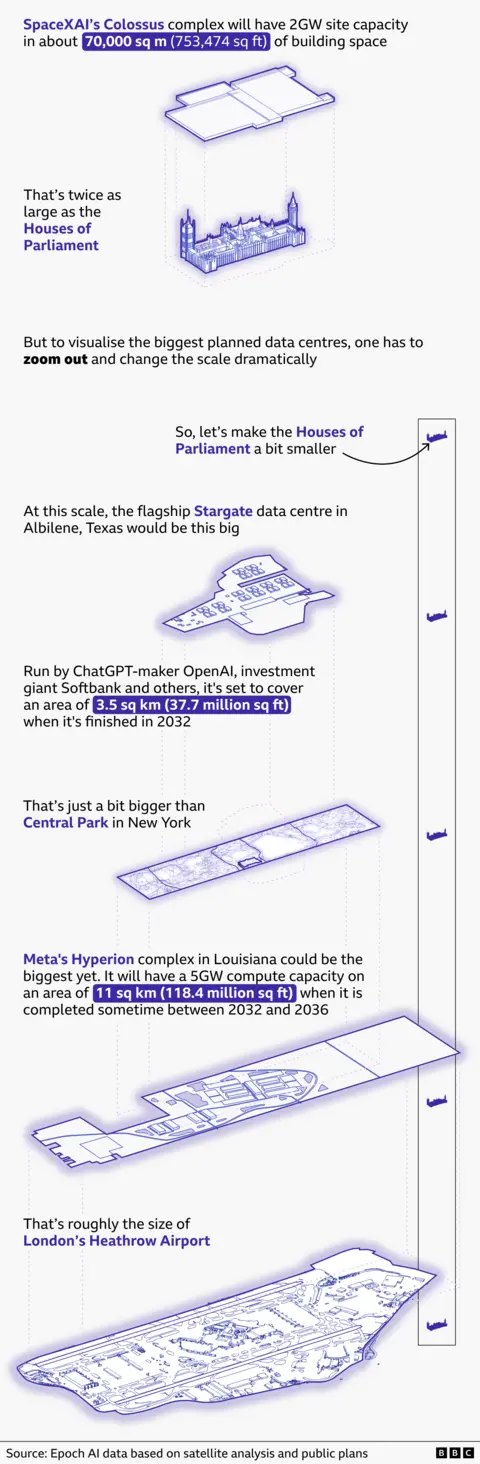
All these sites are being built exclusively to provide the immense computing power needed to run AI services.
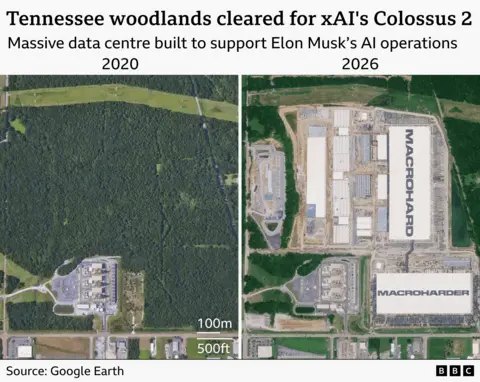
For instance, Colossus 2, which is part of the wider Colossus campus, will house hundreds of thousands of advanced AI chips made by tech giant Nvidia.
It will also be used to train xAI's chatbot Grok. Elon Musk's company will use 41 methane gas turbines to help power the site, which activists say could "significantly increase" local air pollution. Local regulators say the turbines will meet air quality standards.
They use more electricity than France
The pressure data centres put on local resources has sparked increasing concern. These facilities can use significant amounts of water to cool their systems, which could lead to water shortages, some experts say.
Data centres worldwide are also thought to consume more electricity than the whole of France, as the chart below shows.
But they can boost jobs
The type of data centre matters too. So-called hyperscale facilities - massive sites owned and run by tech giants like Amazon and Microsoft - have a bigger positive effect on jobs, it found.
But "colocation" facilities, which lease space to remote tenants without a local presence, brought fewer benefits.
As the debate over their merits intensifies, the data centre rollout continues.
But as concerns about the environmental impact grow, the tech industry is exploring alternatives.
Additional reporting and design by Erwan Rivault, Matt Faraci and Dominic Bailey.